
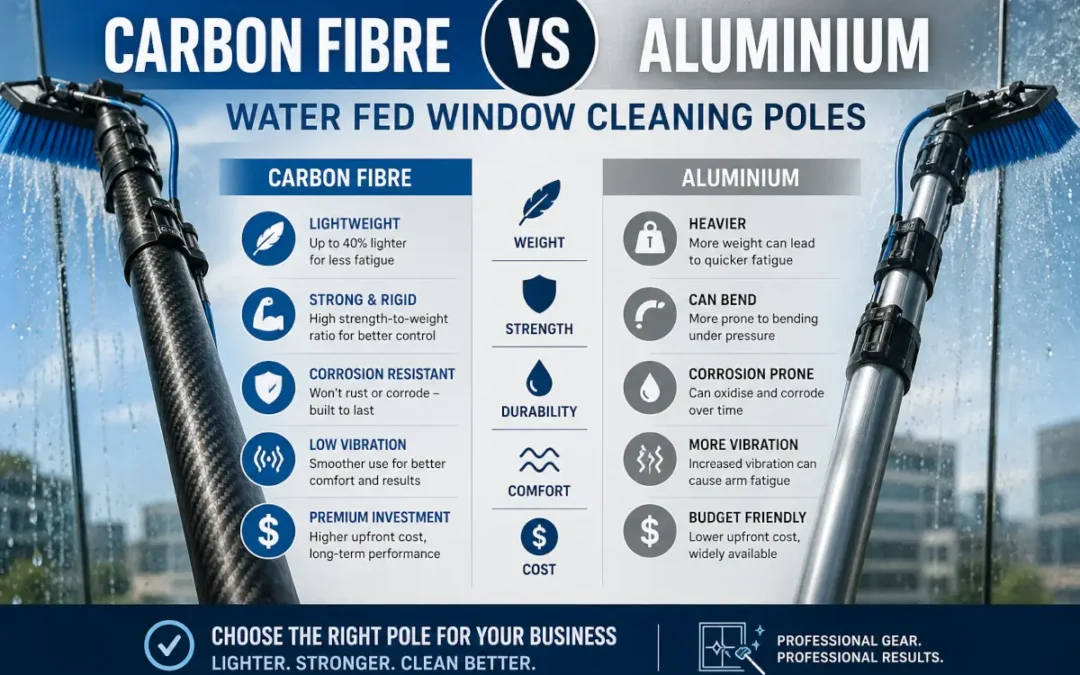
Carbon Fibre vs Aluminium Water Fed Window Cleaning Poles: Which Is Best?
Water fed pole systems have transformed professional window and solar panel cleaning. By delivering pure, de-ionised water through a telescopic pole fitted with a brush head, cleaners can work safely from the ground, reach multi-storey heights, and leave glass streak free without chemicals or ladders.
The pole itself is the critical piece of equipment. Two materials dominate the market, aluminium and carbon fibre. Understanding the differences helps you choose the right tool for residential jobs, commercial high-rise work, or regular solar panel maintenance across South Africa.
Weight
Aluminium poles are noticeably heavier. Carbon fibre composite has a density almost twice as low as aluminium, so a carbon fibre pole of the same length is typically around 40% lighter.
On a long working day this difference matters. Less weight means reduced strain on the shoulders, arms and back. Operators can work longer with better control and lower risk of fatigue-related injuries. For high reach solar panel cleaning or full day commercial contracts, the lighter carbon fibre option is a clear advantage.
Rigidity and Flex
This is one of the biggest performance gaps. Aluminium has roughly 500 kilonewtons of strength, while quality carbon fibre can reach around 1,600 kilonewtons. In practical terms, carbon fibre is two to five times more rigid.
Aluminium poles start to flex and sway noticeably above about 9–10, especially in wind. Controlling the brush becomes harder and the job slows down. Carbon fibre poles stay far stiffer even at 10-15 metres or more. The brush stays where you put it, pressure is more consistent, and cleaning is faster and more precise.
Durability and Longevity
Aluminium is tough and can handle knocks reasonably well, but it is prone to dents that can affect telescopic sections and reduce stiffness over time. It can also corrode if the protective coating is damaged, particularly in coastal or high-humidity environments. It can also bend out of shape permanently if they are over extended and put under load.
Carbon fibre holds its shape better under load and resists corrosion extremely well. It does not dent in the same way, although severe impact can cause more sudden damage (it is stronger but more brittle in extreme cases). With proper care, a good carbon fibre pole will always outlasts an aluminium one in daily professional use.
Cost
Aluminium poles are significantly cheaper upfront. They make sense for occasional use, lower-level work, or as a budget starter option.
Carbon fibre poles cost more — up to 7 – 10 times as much depending on the grade (standard modulus vs high or ultra-high modulus). The higher investment pays off through faster job times, less physical wear on the operator, and longer service life when used regularly at height.
Safety Considerations
Both materials conduct electricity, so neither is ideal near overhead power lines without additional safety measures. Some systems incorporate insulating sections or non-conductive materials for high-risk environments. Always follow proper safety protocols and maintain safe distances from live electrical sources regardless of pole material.
Carbon fibre does not conduct cold as readily as aluminium, which many operators find more comfortable during winter jobs.
Side-by-Side Comparison
| Feature | Aluminium Water Fed Pole | Carbon Fibre Water Fed Pole |
| Weight | Heavier | Significantly lighter (≈40% less) |
| Rigidity / Flex | More flex above ~10 m | Much stiffer, better control at height |
| Durability | Good, but dents more easily | Excellent shape retention, corrosion resistant |
| Upfront Cost | Lower | Higher |
| Best For | Low to mid-height, occasional use | Daily professional use, high-reach work |
| Operator Fatigue | Higher on long jobs | Lower |
Which Should You Choose?
Choose aluminium if:
- You mainly clean single- or double-storey properties
- Budget is the primary concern
- Use is occasional rather than full-time professional
Choose carbon fibre if:
- You regularly work above three storeys or clean large commercial sites and solar arrays
- You want maximum control, speed and reduced physical strain
- You view the pole as a long-term professional investment
Many established window and solar cleaning businesses use a mix: aluminium for quick, low-level jobs and carbon fibre for the demanding high-reach work.
The Bottom Line
Aluminium water fed poles remain a practical, cost-effective entry point. Carbon fibre poles deliver superior performance where it counts most — weight, rigidity and all-day usability. For professional window cleaners and solar panel technicians in South Africa, the move to carbon fibre is often one of the best equipment upgrades they make.
At Window and Solar Cleaning we use high-quality water fed systems chosen for reliability and results on everything from residential glass to commercial façades and rooftop solar arrays. If you would like advice on the right approach for your property or business, get in touch — we’re happy to help.
Cleaner windows and panels. Safer methods. Better results – Window and Solar Cleaning Tech